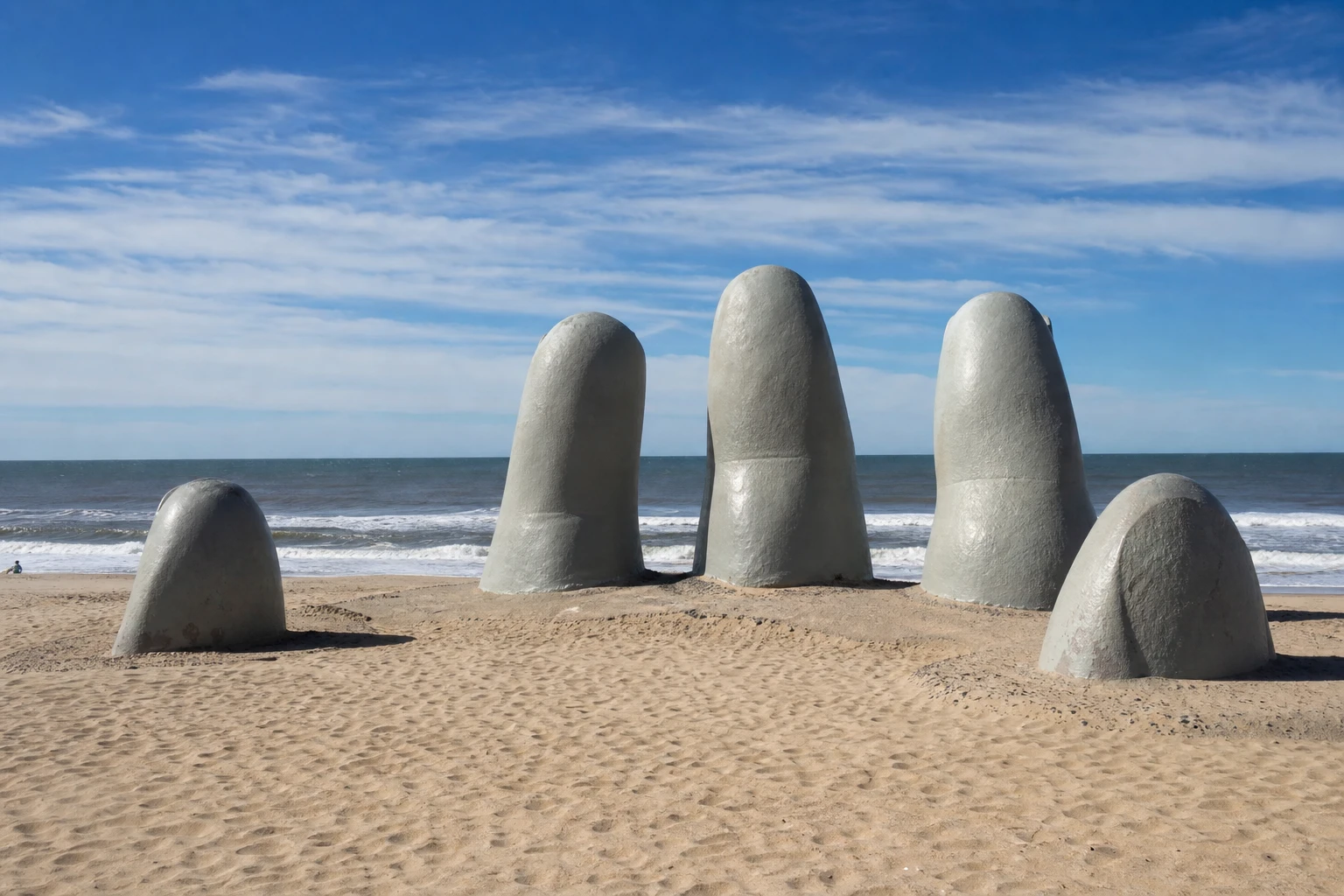
La Mano rises through the sand of Playa Brava like a playful warning from beneath the beach. Also known as Los Dedos and Hombre emergiendo a la vida, the sculpture has become one of Punta del Este’s defining landmarks. A visit is simple, but a little planning helps with navigation, photography, beach conditions and the sandy final approach.
- Find the sculpture on Playa Brava at Parada 1, beside Paseo de las Américas.
- Use “Playa Brava, Parada 1” for navigation because the artwork has several names.
- Visit outside the busiest daytime beach periods for a better chance of an uncluttered photograph.
- Approach by the promenade, where ramps and wide, level pedestrian paths improve access.
- Treat La Mano as a short outdoor landmark stop and combine it with Playa Brava or the Punta del Este Peninsula.
- Check conditions locally before swimming because Playa Brava faces the Atlantic side of the resort.
The artwork stands at the meeting point of public art and beach life. There is no gallery room separating it from the weather, footsteps or shifting activity of Playa Brava. That open setting gives La Mano much of its character. It also means the experience depends on the day’s wind, sand, beach activity and any temporary changes around the approach.

The Best of Punta del Este Old Town Private Walking Tour
Discover the best of Punta del Este’s historic center, from the iconic Fingers sculpture to the historic lighthouse. Learn about the city's colonial...

Candelaria Church and Punta del Este Old Town Private Tour
Step inside a beloved seaside church, admire the 1860 lighthouse, and stand at Uruguay’s southernmost point. Disco...

Punta del Este Classic City Tour with Sunset at Casapueblo
This tour is the best way to get to know Punta del Este in depth. If it's your first time in Punta, we recommend tak...

Punta del Este Shore Excursion: Private Sightseeing Tour of Punta del Este
Explore the sophisticated resort town of Punta del Este on this 4-hour private shore excursion. With a private guide...
Why La Mano deserves a place in your Punta del Este plans
La Mano is immediately recognizable: concrete fingers project through the beach sand while Playa Brava stretches around them. The contrast is direct and memorable. Solid construction meets a landscape that is constantly exposed to the elements, giving photographers a composition that feels different as the light and beach activity change.
This is not a museum-style attraction that fills several hours by itself. Its appeal comes from seeing the artwork in its intended beach setting, taking a few photographs and continuing along the coast. The nearby Paseo de las Américas and Playa Brava make the stop easier to fold into a broader day outdoors.
The monument suits first-time visitors especially well because it communicates Punta del Este’s blend of art, resort culture and Atlantic scenery in a single scene. Its main limitation is equally clear. Travelers looking for shade, indoor interpretation or guaranteed visitor services should regard it as one element of the day rather than the day’s only destination.
Is La Mano worth visiting?
Yes, particularly if this is your first trip to Punta del Este or you enjoy public art and landmark photography. The visit requires little structure and pairs naturally with the beach. Repeat visitors or travelers uninterested in photography may prefer to pass it during a coastal walk rather than plan a separate outing around it.
The story behind the fingers in the sand
Artist Mario Irarrázabal created the work in 1982 for the First International Meeting of Modern Outdoor Sculpture. Municipal accounts describe its construction on Playa Brava using cement and steel rods. More than four decades later, its unusual form remains closely associated with Punta del Este’s cultural and heritage identity.
Its formal name, Hombre emergiendo a la vida, translates as “Man Emerging into Life.” La Mano means “The Hand,” while Los Dedos means “The Fingers.” The shorter names are common in everyday travel planning, but the formal title adds another layer to the scene. The form can feel hopeful, unsettling or humorous depending on the viewer and the weather.
The beach is essential to the work’s effect. Displayed on a conventional pedestal, the fingers would lose the illusion that something larger is pushing upward beneath the sand. Here, the shoreline becomes part of the composition, and every footprint or passing beachgoer changes the surrounding frame without altering the sculpture itself.
Punta del Este has embraced the sculpture as more than a convenient photo prop. Municipal descriptions place it within the resort’s cultural identity and refer to it as an icon. That local significance explains why the artwork continues to anchor the Paseo de las Américas area decades after its creation.
How to find La Mano without getting confused by its names
Navigate to Playa Brava at Parada 1, beside Paseo de las Américas. This is more reliable than searching only for La Mano or Los Dedos, particularly because both names are descriptive and can appear in other contexts. Municipal wayfinding information places the sculpture at Rambla and Playa Brava, Parada 1.
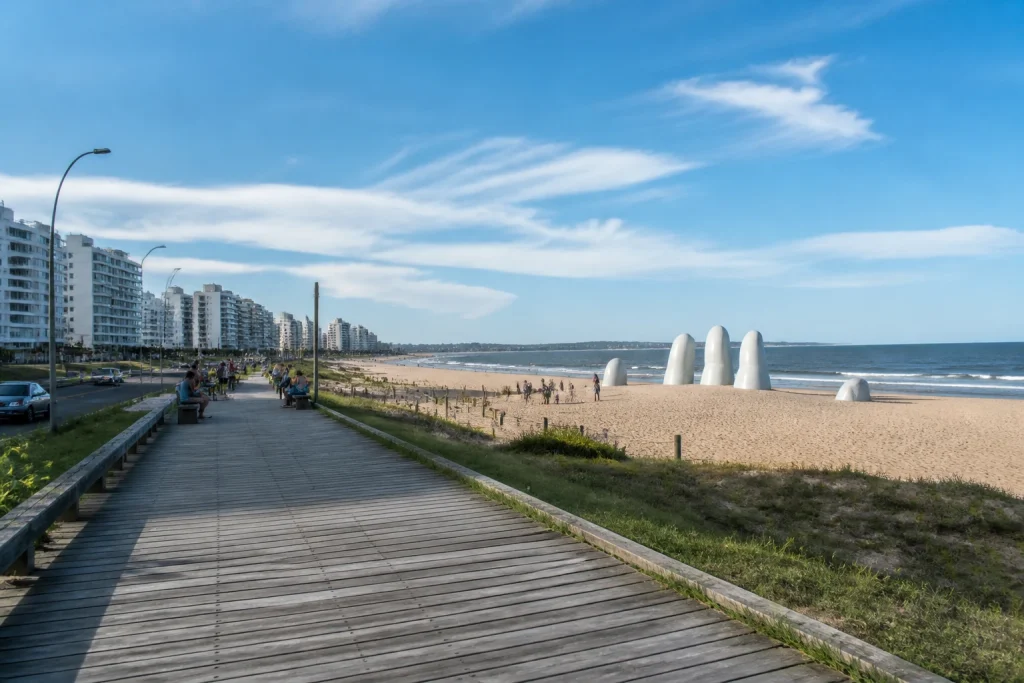
- Enter “Playa Brava, Parada 1, Punta del Este” as the principal destination.
- Use “Paseo de las Américas” as a second reference for the surrounding public space.
- Approach from the promenade and identify the sculpture on the beach rather than trying to cross the sand at an arbitrary point.
- If using a taxi or other hired transport, give the driver both Playa Brava and Parada 1.
Exact bus routes, parking arrangements and tariffs can change, so check current local transport information for the day of your visit. Drivers should also allow for temporary adjustments around the Paseo de las Américas area. Using the full location phrase reduces the risk of being dropped at the wrong part of the beach.
Visitors arriving on foot should favor the promenade approach. The surrounding area has access ramps and broad, level pedestrian paths, although those features do not guarantee an equally firm surface across the sand immediately around the sculpture.
La Mano can also serve as the Atlantic-side starting point for walking the Punta del Este Peninsula past the lighthouse, marina and Gorlero. That longer route adds contrasting urban and waterfront scenes, making the sculpture feel like the opening chapter rather than an isolated photo stop.

Discover Punta del Este: Private City Tour with a Local Guide
Discover Punta del Este in comfort with a private experience designed to let you enjoy the destination at your own p...

Museo Ralli Private Guided Tour in Punta del Este
Step into a world of surrealism and sculpture at Museo Ralli, home to works by Dalí, Chagall, and Latin American ma...

Private Tour in Punta del Este
You will live the Punta del Este experience on an exciting guided tour with personalized service where you will disc...
The best time to visit for photographs and fewer people
Early morning or another period outside the busiest daytime beach hours is the best practical bet for a cleaner composition. La Mano is a major photo stop, so there is no guaranteed crowd-free window. Arriving with time to wait for a brief gap often matters more than chasing a precise minute on the clock.
Low-angle light can reveal texture in the concrete and sand, while overcast conditions reduce hard facial shadows in group pictures. At brighter times, position yourself so your own shadow does not stretch into the frame. Beach wind can move loose sand and expose camera equipment to grit, so change lenses away from the strongest gusts.
- Step back for a wide frame that establishes the Playa Brava setting.
- Try a lower viewpoint without blocking the path or climbing on the artwork.
- Wait for people to finish their photographs before entering the main sightline.
- Use a person in the frame for scale, but keep the sculpture as the clear subject.
- Protect phones and cameras from loose sand, spray and sudden gusts.
Season affects the wider atmosphere of Punta del Este, not just this one landmark. Our guide to Punta del Este’s summer season and off-season helps explain how the resort’s pace changes across the year. Regardless of season, check the day’s weather before committing to a beach-focused itinerary.
Costs, access and conditions around the sculpture
La Mano sits in the public beach landscape rather than inside a museum-style complex. Build your budget around transportation and any applicable parking costs, and avoid assuming that every part of the outing will be cost-free. Local access arrangements can also change during maintenance or busy periods.
What mobility-conscious visitors should expect
The promenade approach offers the most dependable accessible route. Maldonado’s accessibility information reports ramps in the surrounding area and wide, level pedestrian paths associated with La Mano and Paseo de las Américas. These features can make it easier to reach a viewing position near the beach.
The final surface deserves separate consideration. Loose or uneven sand can present a different challenge from a paved promenade, and conditions can shift with weather and beach activity. Wheelchair users and travelers with limited mobility should not assume that every position beside the fingers will be equally accessible. A companion can assess the final approach before equipment is taken onto the sand.
Allow for temporary changes near Paseo de las Américas
The municipality announced maintenance and enhancement work around Paseo de las Américas in April 2026. That does not establish a current closure, but it is sensible to follow any temporary routing present when you arrive. Small changes to paths, gathering areas or the immediate approach can affect where a driver stops and how visitors reach the sand.
Carry what you need rather than relying on shade or guaranteed services beside the sculpture. La Mano works best as a flexible outdoor stop. If comfort facilities are important to your group, plan them as part of the surrounding itinerary instead of expecting the monument itself to operate like a staffed attraction.
What to bring and how to handle Playa Brava conditions
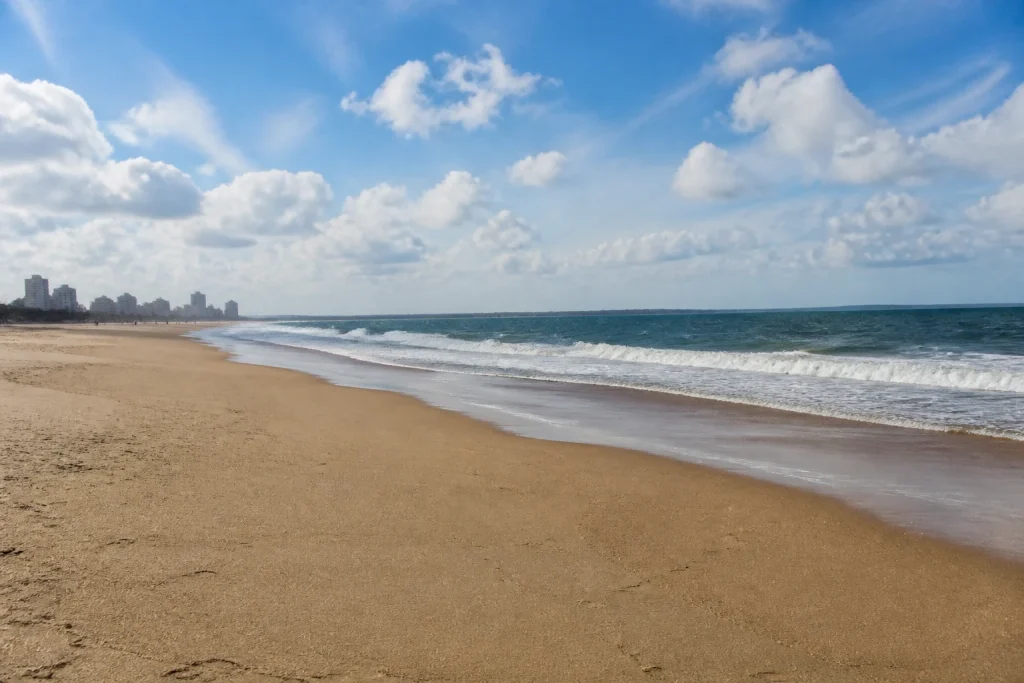
Playa Brava lies on Punta del Este’s Atlantic-facing side, so the beach environment should shape what you carry. Sun, wind and loose sand can turn a quick photograph into an uncomfortable stop when visitors arrive unprepared. A small day bag is usually more practical than bringing equipment that must be set directly on the beach.
- Sun protection, including a hat, sunscreen and sunglasses.
- A light outer layer that can handle exposed coastal conditions.
- Drinking water, especially when continuing along the promenade.
- Footwear that remains comfortable on both paved paths and sand.
- A lens cloth or protective pouch for phones and cameras.
- A compact bag that can stay closed against windblown sand.
Seeing La Mano does not make the surrounding water suitable for swimming on a particular day. Make that decision using the local conditions and safety information present at Playa Brava. Visitors interested only in the sculpture can remain focused on the promenade and beach edge without treating the stop as a swim outing.
Respect the artwork as a cultural landmark. Keep photographs at ground level, avoid climbing on the fingers and give other visitors room to finish their shots. During busy moments, taking turns usually produces better pictures than trying to remove a crowd later through aggressive cropping.
Still comparing La Mano And Los Dedos?
Ask for tour ideas, hotel suggestions, or a simple trip plan that combines both.
Trip Helper
Easy ways to pair La Mano with the rest of Punta del Este
The most satisfying plan combines the sculpture with something larger: a Playa Brava walk, time on the peninsula or a comparison of Punta del Este’s two contrasting coasts. La Mano supplies the signature image, while the surrounding route gives the outing depth and keeps the day from feeling organized around a single photograph.
| Plan | What to combine | Best suited to |
|---|---|---|
| Brief landmark visit | La Mano photograph and a short look at Playa Brava | Travelers with limited time |
| Beach-focused outing | La Mano, the sand and Paseo de las Américas | Visitors comfortable with the day’s weather |
| Peninsula exploration | La Mano followed by a longer urban waterfront walk | First-time visitors who prefer exploring on foot |
| Two-coast comparison | Playa Brava and a separate visit to Playa Mansa | Travelers deciding which beach atmosphere suits them |
For a beach-centered day, begin with the sculpture and continue along Playa Brava only as far as the conditions and your schedule allow. Our comparison of Playa Brava and Playa Mansa explains how the Atlantic-facing setting differs from Punta del Este’s other principal beach environment. That contrast is useful when choosing where to spend more of the day.
For a broader sightseeing day, photograph La Mano before continuing into the peninsula. The sculpture provides a striking first stop, while the later route can emphasize streets, waterfront views and the resort’s urban side. Keep the plan flexible if wind, heat or temporary work around Paseo de las Américas makes the beach less comfortable than expected.
A return visit can still be worthwhile when the light or weather is different, but there is no need to force repeat stops into a short itinerary. Once you have seen the sculpture and its Playa Brava setting, devote the rest of your time to parts of Punta del Este that add a new landscape or activity.
Who will enjoy La Mano most
La Mano is best for first-time visitors, photographers, public-art enthusiasts and travelers already exploring Playa Brava. It also works for groups with mixed interests because the central experience is easy to understand: see the sculpture, appreciate the beach setting and take a photograph before continuing with the day.
- Choose it for a recognizable Punta del Este photograph and a brief cultural stop.
- Combine it with another destination if you want a fuller sightseeing day.
- Plan cautiously if someone in the group finds loose sand difficult.
- Reconsider a dedicated trip during unpleasant beach weather.
- Do not rely on the site for shade, indoor exhibits or guaranteed services.
Mobility-conscious visitors can still appreciate the landmark from the surrounding approach, where ramps and wide, level paths improve access. The important distinction is between reaching the promenade area and crossing the final sand surface. Setting expectations around that difference makes the visit easier to organize.
A practical verdict on visiting La Mano
La Mano earns its place in a Punta del Este itinerary through recognition, setting and simplicity. It is a short encounter with a work created on Playa Brava in 1982, yet the fingers remain closely tied to the resort’s identity. The visit is most rewarding when treated as part of the coast rather than as a self-contained attraction.
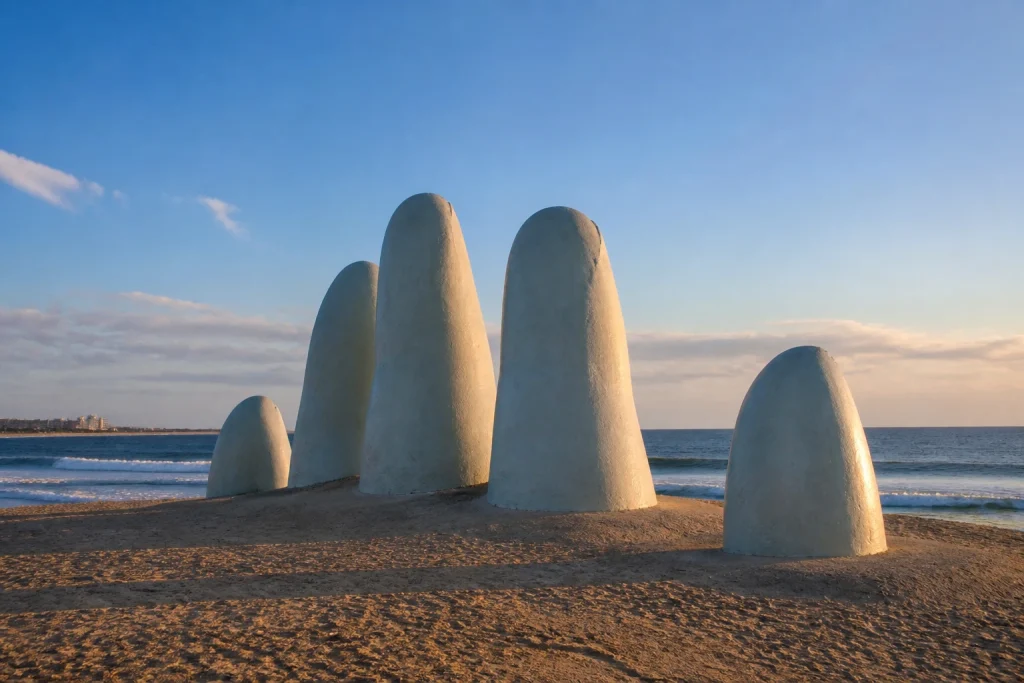
Use Playa Brava, Parada 1 for navigation, favor a less busy beach period, and approach from the promenade. Then continue into a larger plan drawn from the best things to do in Punta del Este for first-time visitors. Bring sun protection, respect the artwork and let the day’s Atlantic conditions determine how long you stay.
Frequently asked questions
Where exactly is La Mano in Punta del Este?
La Mano is on Playa Brava at Parada 1, beside Paseo de las Américas. Use “Playa Brava, Parada 1, Punta del Este” for practical navigation.
Is La Mano also called Los Dedos?
Yes. The sculpture is known as La Mano, Los Dedos and Hombre emergiendo a la vida. Using Playa Brava and Parada 1 with any of these names helps identify the correct location.
What costs should I plan for when visiting La Mano?
Budget for transportation and any applicable parking costs. La Mano is a public outdoor monument rather than a museum-style attraction, but local access and parking arrangements can change.
When is the best time to photograph La Mano?
Early morning or another period outside the busiest daytime beach hours is the best practical choice. The sculpture is a popular photo stop, so a completely empty scene is never guaranteed.
Is La Mano wheelchair accessible?
The promenade approach has ramps and wide, level pedestrian paths, but the sand immediately around the sculpture should not be assumed wheelchair-friendly. Conditions across the final beach surface can vary.
Can I swim at Playa Brava during the same visit?
A visit to La Mano is not a swimming recommendation. Playa Brava faces the Atlantic side of Punta del Este, so make swimming decisions using the beach conditions and safety information available that day.
How long should I spend at La Mano?
La Mano works best as a short photo and beach stop rather than a self-contained museum visit. Allow extra time if you want to walk along Playa Brava or continue through the Punta del Este Peninsula.
Who created La Mano, and when?
Mario Irarrázabal created the work in 1982 for the First International Meeting of Modern Outdoor Sculpture. It was built on Playa Brava using cement and steel rods.
The Best of Punta del Este Old Town Private Walking Tour
Discover the best of Punta del Este’s historic center, from the iconic Fingers sculpture to the historic lighthouse. Learn about the city's colonial...
Punta del Este Classic City Tour with Sunset at Casapueblo
This tour is the best way to get to know Punta del Este in depth. If it's your first time in Punta, we recommend tak...
Punta del Este Shore Excursion: Private Sightseeing Tour of Punta del Este
Explore the sophisticated resort town of Punta del Este on this 4-hour private shore excursion. With a private guide...
Experiences to explore
 Explore experience ↗
Jewish History Punta del Este Old Town Private Walking Tour
◷ 3 hr
Uncover Punta del Este’s Jewish heritage as you explore synagogues, cultural landmarks, and hidden gems. Stroll through vibrant markets
See dates for Current pricing
View dates Explore experience ↗
Jose Ignacio Beach from Punta del Este
◷ 4 hr
Discover José Ignacio and its quiet beaches. Located 40 km from Punta del Este, José Ignacio is a beautiful town known as an oasis of p
See dates for Current pricing
View dates Explore experience ↗
Piriapolis Beach from Colonia del Sacramento or Montevideo
◷ 4 hr
Beautiful opportunity to get to know Piriapolis on this city tour through the city enjoying the most important and beautiful and mystic
See dates for Current pricing
View dates