Punta del Este offers several distinct visual settings within a compact coastal area: sculpture against surf, historic streets around a lighthouse, long waterfront perspectives, and white architecture facing the sea. The strongest photography plan combines an early visit to La Mano with a peninsula walk, then treats Casapueblo and Isla Gorriti as separate outings. That approach leaves room for changing light, marine conditions, and the occasional passerby who walks into an otherwise perfect frame.
- Photograph La Mano at Playa Brava early in the day for softer light and a better chance of a simple composition.
- Follow the Rambla de Circunvalación into the Faro district for coastal views and historic streetscapes.
- Plan Casapueblo as a separate Punta Ballena outing, ideally with enough time to compose before sunset.
- Treat Isla Gorriti as a weather-dependent detour and confirm the active boat schedule locally.
- Check beach flags, marine conditions, admission details, and accessibility arrangements on the day.
A phone is enough for the main viewpoints, but each location rewards a different technique. Use low angles at La Mano, layers and leading lines on the rambla, careful highlight control at Casapueblo, and a fast shutter from a moving boat. The goal is not to race through a checklist. Give each subject time, watch how people move through the frame, and change position before reaching for digital zoom.

Punta del Este Shore Excursion: Private Sightseeing Tour of Punta del Este
Explore the sophisticated resort town of Punta del Este on this 4-hour private shore excursion. With a private guide, enjoy a scenic drive with stunni...

Jewish History Punta del Este Old Town Private Walking Tour
Uncover Punta del Este’s Jewish heritage as you explore synagogues, cultural landmarks, and hidden gems. Stroll th...

Private Have It Your Way Tour in Punta Del Este
Be prepared for an exclusive trip through Punta del Este with a true local! We will share our knowledge in an engag...

Punta del Este Shore Tour for Cruise Passengers
Join us on a tour to discover Punta del Este, one of Latin America’s most exclusive destinations. With its elegant...
1. La Mano at Playa Brava: Punta del Este’s essential photograph
La Mano stands at Playa Brava on Rambla Brava, Parada 1. The sculpture belongs to Punta del Este’s recognized group of Latin American sculptures and provides the city’s clearest landmark image. Its position beside an open beach lets you compose it with sand, sky, and the Atlantic-facing shoreline rather than a busy architectural background.
How to compose La Mano
Begin several steps back and photograph the full sculpture with space around it. A low camera position makes the hand more prominent and reduces background clutter. Next, move closer for details where the sculpture meets the sand. Vertical framing suits the upward reach of the fingers, while a horizontal frame works better when the shoreline and sky carry equal visual weight.
People can add scale, but they also change the mood. For a clean landmark portrait, wait for a short gap and keep the horizon level. For a livelier travel photograph, frame visitors beside rather than directly in front of the sculpture. Burst mode helps when movement is unpredictable, especially if wind is making clothing and hair part of the composition.
Best light and beach safety
Early morning is a practical choice for softer light and a calmer shooting process, though neither light nor crowd levels are guaranteed. Late afternoon can also produce appealing color and longer shadows. Playa Brava can have rough surf, so stay well back from the waterline when conditions are poor. Check the beach flags and follow local lifeguard guidance before placing yourself or camera equipment near the sea.
The setting also helps explain the visual differences between the resort’s two principal beach environments. A Playa Brava versus Playa Mansa comparison is useful if you want to pair La Mano’s energetic shoreline with a different coastal mood later in the day.
2. Casapueblo: sculptural architecture at sunset
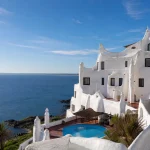
Casapueblo is in Punta Ballena, 13 kilometers from Punta del Este, so it deserves its own excursion rather than a rushed addition to a peninsula walk. Created by Carlos Páez Vilaró, the building faces the sea and provides the area’s strongest combination of architecture and sunset light. Its clustered white forms create bold curves, shadows, and repeating shapes before the sky begins to change color.
Build the frame before the sun drops
Arrive with enough time to study the building in daylight. Look for overlapping white forms, dark openings, and sections where the architecture can frame a strip of sea. A moderately wide composition establishes the setting, while tighter images emphasize texture and geometry. Avoid pushing the white balance so warm that the building loses its natural color.
At sunset, expose for the bright sky and allow some shadows to deepen. Phones usually handle this well when you tap near the brightest cloud and reduce exposure slightly. Cameras benefit from exposure bracketing if the difference between sky and architecture is severe. Keep shooting for a short period after the sun reaches the horizon, when the building and sky can settle into a more balanced range.
Sunset draws visitors, so accept some people as part of the scene or choose a tighter composition that excludes them. Current admission, opening times, photography rules, and visitor arrangements should be checked before leaving Punta del Este. The dedicated guide to Casapueblo at sunset offers a useful framework for making this Punta Ballena ritual the centerpiece of an evening.
3. Rambla de Circunvalación and the historic Faro district
The Rambla de Circunvalación is a pedestrian promenade around the peninsula, making it the best foundation for a varied walking shoot. Instead of relying on one landmark, use the route to collect open-water scenes, curved coastal lines, distant figures, and transitions between the shore and city streets. A small camera or phone works well because it lets you react without stopping to unpack equipment at every turn.

Still comparing Sightseeing?
Ask for tour ideas, hotel suggestions, or a simple trip plan that combines both.
Trip Helper
Use the waterfront as a sequence, not one viewpoint
Photograph the rambla in layers. Place the promenade in the foreground, the coast in the middle distance, and open sky beyond it. Curves in the path can guide the eye through a horizontal frame. For a stronger sense of movement, wait for one walker or cyclist to enter a clean section rather than filling the scene with many unrelated figures.
Wind and reflected light can change quickly beside the water. Check the lens for spray or fingerprints, then take both a bright and slightly darker version of important compositions. A polarizing filter can reduce glare, but rotate it carefully so the sky does not become uneven in a wide-angle image. On a phone, a brief adjustment to exposure is often more useful than a heavy filter effect.
Photograph the Punta del Este Lighthouse from the street
The lighthouse area around Calle 10 and Plaza del Faro is Punta del Este’s historic zone. The district includes early summer residences, the church, a meteorological station, and the lighthouse. Together, these subjects provide a more restrained visual counterpoint to the beach towers and waterfront scenery associated with the wider resort.
Treat the Punta del Este Lighthouse as an exterior and streetscape subject. It is a landmark at the end of the peninsula and has historic-monument status, but a climb or public viewpoint should not be assumed. Step back enough to keep the tower vertical, then use nearby building lines or a corner of the street to give it context. A longer focal length can isolate the upper section against the sky.
The full walking-the-peninsula route through the lighthouse, marina area, and Gorlero provides a broader plan for visitors who want to keep exploring after photographing the Faro district. For this photo-focused outing, leave extra time around the historic streets instead of measuring success by distance covered.
4. Isla Gorriti: Punta del Este from the water
Isla Gorriti adds a water-level perspective that the peninsula cannot provide. Yacht trips leave from Puerto de Punta del Este, and visitors can spend time on the island’s beach or swim. For photographers, the crossing and shoreline create opportunities to place Punta del Este across open water, giving the built-up coast more breathing room inside the frame.
Shooting from a moving boat
Use a fast shutter or your phone’s burst mode during the crossing. Keep the camera strap secure and brace your elbows against your body rather than a vibrating rail. Wide compositions communicate the distance between island and city, while a moderate zoom can compress the skyline across the water. Protect the lens from spray and wait until the boat slows before attempting careful horizon alignment.
On the island, include a strip of beach or vegetation in the foreground to establish where the photograph was made. A completely empty horizon can look detached from the experience. If the midday light is harsh, look for side-lit textures, reflections, or human-scale beach scenes instead of forcing a dramatic sky that is not there.
Boat schedules, fares, operating seasons, and cancellation arrangements vary, and marine conditions can affect crossings. Confirm the active departure details at the port before building the day around Isla Gorriti. Travelers who need assistance with boarding or transfers should discuss the setup directly with the boat operator before booking.
5. An efficient photo route for one or two days
The simplest route groups La Mano and the peninsula together, then separates the two places that depend on transportation or operating arrangements. This protects the best light from unnecessary backtracking and leaves flexibility if a boat is not running or coastal conditions change.
- Start at La Mano on Playa Brava during the softer morning light.
- Continue around the peninsula using the Rambla de Circunvalación as the visual thread.
- Slow down in the Faro district for lighthouse exteriors and historic streetscapes.
- Make Casapueblo a separate late-day outing rather than squeezing it into the walk.
- Place Isla Gorriti on a second day or keep it flexible until the boat schedule and marine conditions are clear.
Trying to combine an island trip with a fixed sunset plan creates unnecessary pressure. If Isla Gorriti is important, give the crossing its own generous window and keep Casapueblo for another day. If time is limited, prioritize La Mano, the rambla, and the Faro district. They form the most practical outdoor sequence without depending on museum entry or a boat departure.
Light, visitor numbers, and operating patterns change through the year. The guide to Punta del Este’s summer season versus the off-season can help place this photography route within a wider trip plan, especially if you are still choosing travel dates.
6. Simple techniques for stronger coastal photographs
Punta del Este’s best-known subjects do not require a large camera bag. One wide or standard lens, a secure strap, a lens cloth, a charged battery, and spare phone power cover most situations. A telephoto lens is useful for isolating the lighthouse or compressing the city across the water, but it is optional. Pack equipment you can carry comfortably through a long peninsula walk.

- Clean the lens often, especially after time near wind and sea spray.
- Keep horizons level unless a deliberate tilt clearly improves the composition.
- Take one wide establishing image, one medium scene, and one close detail at each stop.
- Use exposure compensation to protect bright sunset skies and white architecture.
- Turn off aggressive digital zoom and move closer when the location and safety conditions allow.
- Ask permission before making a recognizable person the main subject of a photograph.
Photograph beyond the postcard angle
After securing the obvious view, turn around. At La Mano, study tracks and shadows in the sand. Near the lighthouse, look for the relationship between the tower and surrounding streets. At Casapueblo, isolate a curve, opening, or patch of reflected color. On Isla Gorriti, use the island foreground to change how the distant city reads. These secondary frames often describe the destination more clearly than a centered landmark alone.
Cloud cover is not a wasted day. Flat light can preserve detail in white buildings and reduce harsh contrast in street scenes. Wind can add motion to clothing, water, and vegetation. When the weather does not match the image you expected, simplify the composition and work with texture, shape, and human scale instead.
7. Costs, changing conditions, and accessibility
| Photo stop | Planning category | What to confirm |
|---|---|---|
| La Mano and Playa Brava | Public outdoor landmark | Same-day beach conditions and lifeguard guidance |
| Rambla and Faro district | Public outdoor route and exterior views | Local conditions if weather is poor |
| Casapueblo | Separate attraction outing | Current admission, opening times, photography rules, and visitor access |
| Isla Gorriti | Boat trip and island visit | Active schedule, fare, marine conditions, boarding arrangements, and return details |
La Mano, the rambla, and exterior views in the Faro district are public outdoor stops rather than museum visits. Casapueblo admission and Isla Gorriti transport are potentially paid parts of the plan. Check current prices directly because tariffs can change and no fixed amount belongs in a flexible photography itinerary.
Check Playa Brava conditions before approaching the water, confirm the island crossing before relying on it, and expect sunset to attract other visitors at Casapueblo.
Do not assume that every stop has the same level of step-free access. Beach surfaces, island boarding, museum circulation, toilets, and transfers require location-specific information. Travelers with mobility needs should confirm the exact route and assistance available with the relevant venue or boat operator before setting out. The municipal listing identifies La Mano’s location, but it does not establish that every part of the beach experience is accessible.
8. Which Punta del Este photo spots should you prioritize?
Choose La Mano first if you want the unmistakable Punta del Este image. Add the Rambla de Circunvalación and Faro district for a fuller account of the peninsula, with coastal lines and historic architecture in the same walk. Casapueblo is the strongest choice for travelers who value expressive architecture and sunset, while Isla Gorriti suits those willing to keep their schedule flexible around transport and marine conditions.
A successful photo day needs only three things: one landmark, one unhurried walk, and enough time to respond to the light. Begin at Playa Brava, explore the peninsula without rushing, and reserve the more complicated outings for the conditions that suit them. You will return with a more varied set of photographs and a better sense of Punta del Este than any single postcard angle can provide.
Frequently asked questions
What is the most important photo spot in Punta del Este?
La Mano at Playa Brava is the essential landmark photograph. Find it on Rambla Brava at Parada 1, and consider visiting early in the day for softer light and a less hurried composition.
Where is the best place to photograph sunset near Punta del Este?
Casapueblo at Punta Ballena is the leading architecture-and-sunset choice. It is 13 kilometers from Punta del Este, so plan it as a separate outing and check current visitor details before departure.
Which Punta del Este photo spots can be combined on foot?
La Mano, the Rambla de Circunvalación, and the Faro district form the most practical outdoor sequence. The rambla continues around the peninsula, while the lighthouse area adds historic streets and exterior architecture.
Can visitors climb the Punta del Este Lighthouse?
Do not plan your visit around climbing the lighthouse. Treat it as an exterior landmark and streetscape subject because current public entry, tower-access hours, and admission details are not established here.
How do visitors reach Isla Gorriti?
Trips to Isla Gorriti depart by yacht from Puerto de Punta del Este. Confirm the active schedule, fare, return arrangements, and marine conditions locally because these details can vary.
Are the Punta del Este photo spots free to visit?
La Mano, the rambla, and exterior views in the Faro district are public outdoor stops rather than ticketed museum visits. Casapueblo admission and transport to Isla Gorriti can add costs, so check current prices before finalizing the plan.
Are these photo locations wheelchair-accessible?
Accessibility varies by location and should not be assumed across the route. Confirm beach surfaces, museum circulation, boat boarding, transfers, and any required assistance directly with the relevant venue or operator.
La Mano at Playa Brava is Punta del Este’s essential landmark photograph by Isabeltorrado, CC BY-SA 3.0.
Experiences to explore
 Explore experience ↗
Punta del Este & Coastal Villages Private Tour
◷ 7 hr
Discover the beauty, culture, and artistic charm of Punta del Este and its surroundings on this private 4-6 hour tour. From the stunnin
See dates for Current pricing
View dates Explore experience ↗
Private Photo Session with a Local Photographer in Punta del Este
◷ 30 min
Want to capture your amazing honeymoon? Family vacation while the kids are still little? Your perfect couples retreat from everyday bus
See dates for Current pricing
View dates Explore experience ↗
Punta del Este Classic City Tour with Sunset at Casapueblo
◷ 4 hr 30 min
This tour is the best way to get to know Punta del Este in depth. If it's your first time in Punta, we recommend taking the City Classi
See dates for Current pricing
View dates